
Enhancing Safety Onsite
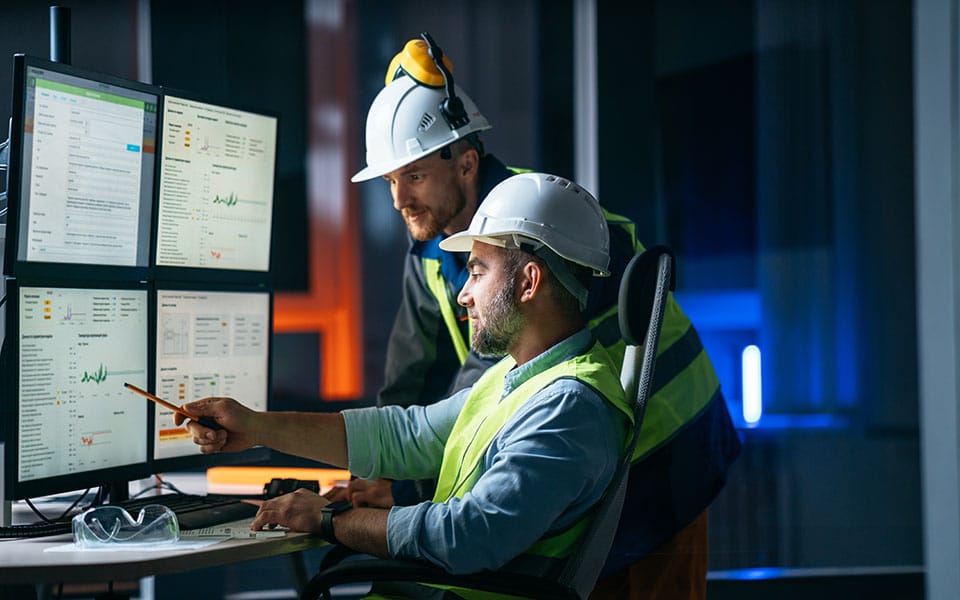
One of the industry’s most common forms of waste is rework, which causes delays, increases costs, and compromises safety, project timelines, and labor availability. Rework refers to any completed work that needs fixing or altering, and it’s a notorious safety hazard, estimated to be associated with up to 39% of construction injuries. AI technology can help reduce instances of rework and protect laborers by enhancing safety protocols when rework can’t be avoided and reducing rework through the application of Building Information Modeling (BIM) technology. BIM allows teams to simulate the building process, refining the design and anticipating challenges that would otherwise arise unanticipated on the job site. In the BIM context, AI generally helps automate repetitive design tasks, applies style parameters to designs, or uses real-world scanning data to generate virtual models. That means BIM is easier to work with and more accurate to the real-world equivalent—exactly the features necessary to help avoid rework. There are a wide variety of AI solutions supporting general safety efforts. Some are as simple as monitoring job sites to track the proper use of required safety equipment, while others scan and issue alerts for potential hazards. Interconnected devices can even feed live data from sensors to monitor sites and trigger alerts as necessary.Facilitating Smart Construction Management
Beyond robust safety applications, AI can provide huge project management advantages. AI solutions are available for managing inventory, measuring project progress, scheduling, and staffing. These tools can help a site run more efficiently by forecasting, revising forecasts in the face of delays, balancing crew workloads to prevent fatigue, ensuring materials are available, and more. AI used in conjunction with technology on site can also empower managers to take responsibility for more active projects, providing them with on-the-ground perspectives that can be accessed from anywhere there’s an internet connection. This not only means more productivity from key team members but also helps to ensure projects receive the dedicated attention they require to meet high quality standards.Solving for Backoffice Inefficiency
There are a variety of AI-powered systems designed to make the day-to-day responsibilities of running a business much easier, including billpaying, submitting invoices, generating reports, and more. Construction industry-specific solutions are also available; they take the concept of an AI-powered back office one step further by incorporating features that assist with estimates, safety, design, quality control, and project planning. These tools can significantly influence cash flow and profitability by anticipating material needs, preventing stockouts and overstocking, and using predictive modeling to find and flag patterns of activity that lead to cost overruns and delays. With help identifying red flags, those issues can be more easily recognized, avoided, or mitigated before they become costly. AI can also analyze financial performance data to generate insightful reports on the profitability of past and present work. This provides valuable insight that can inform overall business strategy and help determine the types of jobs that are most worth pursuing. In the context of controls, forensic AI tools can process and analyze payments of all sorts, identifying anomalous payments and other suspicious behavior for further investigation. At its current rate of evolution, there’s no telling how much backoffice support AI will provide a year from now. Already, the most trusting early adopters use AI to automate bank reconciliation. Those brave enough to apply AI in high-risk contexts like reconciliations should also employ thorough vetting and oversight practices to minimize the chance of errors.Improving Contracts
Effective contract management is becoming more essential as costs rise and margins shrink. Make stability and cost efficiency the cornerstone of every contract by leveraging AI systems to enhance the contract management and related processes. They can be configured to analyze contract-related data, recommend optimal terms, monitor compliance, and track performance. These solutions can integrate seamlessly with existing financial management tools to provide constant oversight of contractual obligations and report on their financial ramifications. AI can be especially helpful in determining the details within long-term supplier agreements. With this support, your long-term contracts can provide stability while locking in optimal value. AI can also help in identifying suppliers, making it easier to overcome supply chain disruptions or cut down on expensive transportation costs. Additionally, it can help inform agreements that feature price escalation clauses, using advanced modeling to manage the risks associated with potential increases in material and labor costs.Future-proof Your Finances
As AI adoption increases, the technology will offer more crucial business advantages. Protect your competitive edge by adopting systems and practices that will grow alongside your business. AI technology is already delivering substantive benefits by managing and analyzing data to issue reports virtually in real-time, support safety measures, facilitate scheduling, and more. By harnessing it, construction firms can unlock greater efficiency, seize the right opportunities, overcome persistent challenges, and mitigate some of the factors driving up material costs One final advantage of AI is less about the tools themselves and more about what they mean for the construction industry. Construction is seen as a stubbornly traditional sector, potentially to a fault. Embracing AI could give your business the future-focus needed to attract young talent who are determined to push the envelope. Offering the tools they need to make an impact could be the difference between an energetic, driven, and robust workforce, and a dwindling crew that shrinks further with each retirement party. The future of our industry is taking shape—where will you fit in?