
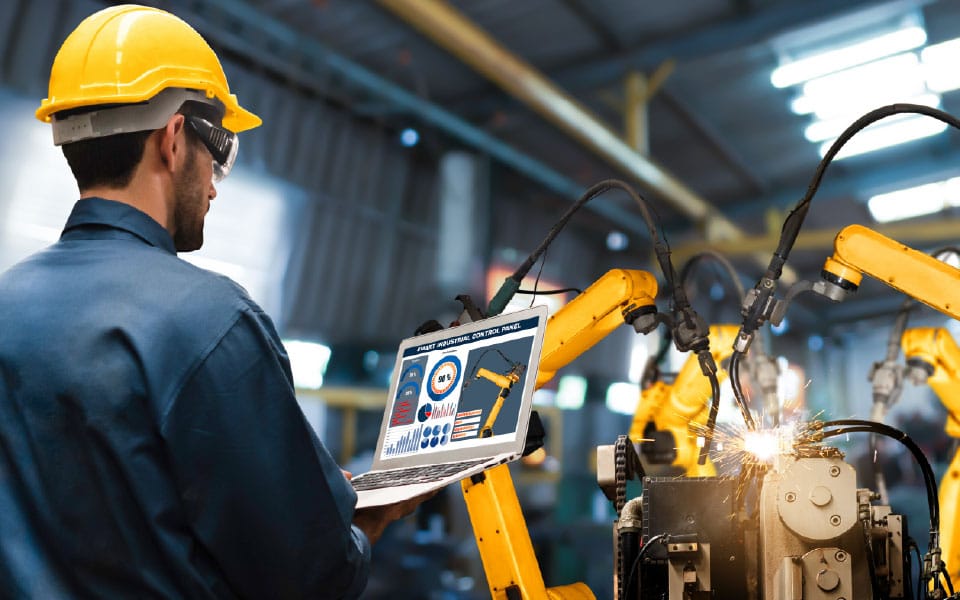
Manufacturing has long turned breakthrough technologies into competitive advantage—from robotics on the assembly line to software-driven design and rapid prototyping. Artificial intelligence is the next step in that progression. When applied thoughtfully, AI improves decision-making, accelerates execution, and frees teams to focus on higher‑value work. Below is a streamlined view of where AI is already delivering value and how to integrate it effectively in your environment.
Back-Office Transformation
AI’s earliest and most accessible benefits often appear in the back office. These use cases are largely industry-agnostic, but they create the foundation for broader operational gains.
Materials management and supply chain
- Forecast demand and consumption using historical data and external signals.
- Automate routine tasks such as purchase order creation and reorder triggers.
- Use predictive models to align inventory levels with production needs and reduce stockouts or overages.
Payroll and workforce administration
- Automate data entry and routine validations to reduce manual effort.
- Flag discrepancies in pay data for review and support compliance with tax and labor requirements.
- Enable employee self-service for on-demand access to payroll information.
Reconciliations and repetitive data work
- Apply generative AI to compare large datasets quickly, identify out-of-balance conditions, and surface exceptions.
- Standardize and streamline high-volume, rule-based tasks that consume team capacity.
Reporting and operational insights
- Generate reports on demand using current data sources and standard templates.
- Enable rapid customization so managers can view performance from multiple angles without waiting on manual compilation.
Compliance and forecasting
- Analyze large, multi-source datasets to measure program effectiveness and control adherence.
- Improve forecast reliability by incorporating more variables and historical patterns than is practical manually.
AI on the Factory Floor
The most distinctive value for manufacturers comes where products are designed, built, and tested. Here, AI helps increase uptime, raise quality, and accelerate time to market.
Predictive maintenance and asset health
- Integrate sensor readings, machine logs, error histories, and service records.
- Use statistical and machine learning models to anticipate failures and schedule maintenance proactively.
- Extend equipment life and reduce unplanned downtime by addressing issues before they become outages.
Troubleshooting and knowledge assistance
- Ingest equipment manuals, service bulletins, and maintenance logs into an AI knowledge base.
- Describe a symptom and receive step-by-step diagnostic guidance tailored to your specific equipment and history.
- Shorten mean time to repair by getting technicians to the likely root cause faster.
Product development and manufacturing documentation
- Generate draft manufacturing documentation, bills of materials, and purchase lists from component specifications.
- Standardize templates to speed review and approval cycles for new product introductions.
Testing and quality control
- Use computer vision to detect defects and deviations on the line.
- Run digital simulations to evaluate performance before physical testing.
- Optimize test sequencing and scheduling to balance throughput with coverage.
Making AI Work in Your Environment
AI is not a plug-and-play solution. Its value depends on the quality of your data, the strength of your integrations, and the suitability of the problems you choose to tackle. Focus on these fundamentals:
Data readiness
- Ensure access to accurate, timely data from systems of record, machines, and sensors.
- Define data ownership, quality standards, and refresh cadences.
Integration
- Connect AI services to your ERP/MES, planning tools, and factory equipment where appropriate.
- Plan for bidirectional data flows so insights can trigger actions in source systems.
Security and governance
- Protect sensitive information with appropriate controls, role-based access, and audit trails.
- Establish clear policies for model use, monitoring, and change management.
Use-case selection
- Start with high-impact, repeatable processes where AI can measurably reduce cost, time, or risk.
- Define success metrics up front and validate outcomes against business goals.
People and process
- Involve end users early to ensure solutions fit real workflows.
- Provide training and create feedback loops so the system improves with use.
Continuous improvement
- Monitor performance, capture exceptions, and iteratively refine models and prompts.
- Scale to adjacent processes once value is proven.
Conclusion and Next Steps
Applied effectively, AI reduces errors, accelerates timelines, and expands the information available to decision-makers—without adding headcount. It allows your team to concentrate on strategic priorities while automating repetitive, data-heavy work.
To realize these benefits, integrate AI where it can access the right data, connect to your existing tools, handle sensitive information securely, and address well-chosen tasks. If you have questions about your organization’s AI readiness, or want to learn more about Vertical Vector, a generative AI platform built by CBIZ for the middle market, contact a CBIZ professional.